Eighth class, October 20th
Afternoon class: Lower East Side Galleries:
Reena Spaulings, 165 East Broadway
Stephen Willats,The Strange Attractor
Lu Magnus, 55 Hester Street
Kboco, Efeito Esquimó
Bosi Damjanovic Gallery, 48 Orchard Street
BEATRICE SCACCIA AND MARTA JOVANOVIC
Rachel Uffner, 47 Orchard Street
Sara Greenberger Rafferty: Remote
Scaramouche, 52 Orchard Street
Seher Shah: Object Anxiety
Laurel Gitlen, 261 Broome Street
Ryan Foerster, Jessica Jackson Hutchins, Chadwick Rantanen
Bridge Gallery, 98 Orchard Street
Ship of Fools
Mulherin + Polland, 187 Chrystie Street
JIMMY TROTTER , The Sweetest Kill; Daydreaming Animals
Lehmann Maupin, 201 Chrystie Street
Mickalene Thomas: More Than Everything
Sixth Class, October 6, Chelsea Field Trip 2
Galleries visited (morning class):
Marlborough, Vincent Desiderio, 545 W. 25th
Gagosian Gallery, Richard Serra, 555 W. 24th
I20 Gallery, Karen Heagle, 557 W. 23rd
Matthew Marks, Thomas Demand, 522 W. 22th
Haunch of Venison, Boundaries Obscured (Group Show),
550 W. 21st
550 W. 21st
Gladstone, Matthew Barney, 530 W. 21st
Zwirner, Lisa Yuskavage, Yutaka Sone, 519 W. 19th
Galleries visited (afternoon class):
All of the above except Matthew Marks, and also
Sikkema Jenkins & Co., Vik Muniz, 530 W 22nd
Zoe/Vic Muniz
Zelda/Stella
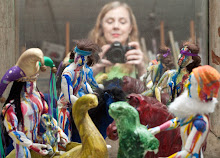
Juliet/Patricia Piccinini
4th class - September 22 - Field Trip to 57th St. Galleries
Morning class:
Red Grooms at Marlborough Gallery, 40 W. 57th St., 2nd Floor
Ana Tzarev Gallery, 24 West 57th St.
Niki de Saint Phalle at Nohra Haime, 730 5th Avenue, Suite 701
Ad Rienhardt at Pace, 32 East 57th, 2nd Floor, Louise Nevelson on the 3rd floor.
Afternoon class (and morning class also if possible):
All of the above, plus Willem de Kooning at the Museum of Modern Art, 53rd St. between
5th and 6th Avenues, 6th Floor.
Red Grooms at Marlborough Gallery, 40 W. 57th St., 2nd Floor
Ana Tzarev Gallery, 24 West 57th St.
Niki de Saint Phalle at Nohra Haime, 730 5th Avenue, Suite 701
Ad Rienhardt at Pace, 32 East 57th, 2nd Floor, Louise Nevelson on the 3rd floor.
Afternoon class (and morning class also if possible):
All of the above, plus Willem de Kooning at the Museum of Modern Art, 53rd St. between
5th and 6th Avenues, 6th Floor.
2nd Class Fall 2011, Sept. 8
Morning class, first gallery visited.
(Greg Drasler at Betty Cuningham)
Afternoon class, last gallery visited.
Morning class:
Betty Cuningham Gallery
541 W. 25th
Greg Drasler
Cheim and Read
547 W 25th
Women in Our Life
Lyons Wier
542 W. 24th
Tim Okamura “Brooklyn – Bronx – Queens”
Koenig Gallery
545 W 23rd
Sigmar Polke: Photoworks
Jack Shainman Gallery
513 W. 20th
Nick Cave
Jack Shainman Gallery
513 W. 20th
Nick Cave
Elizabeth Harris Gallery
529 W. 20th
Maja Lisa Englehardt, 9/8 – 10/8
Howard Scott Gallery
529 W. 20th
529 W. 20th
Yuriko Yamaguchi
Afternoon class: All of the above, plus the following:
I-20 Gallery 557 W 23rd
Make Skateboards
Matthew Marks 522 W. 22nd
La Carte D’Apres Nature, curated by Thomas Demand
Andre Zarre Gallery 529 W. 20th
Anya Rubin
Kathryn Markel 529 W. 20th
Trine Bumiller
Fall 2011 Class Syllabus and Essay Specifications
The following information will be discussed during the first class session. Also we will introduce ourselves and speak a little about our current artwork. You could bring an example to class if it isn't too big.
Class Requirements and Grading: Your grade will be based on the following five areas:
1. Weekly, on-time attendance.
Any absence must be discussed with me, and you are responsible for any information and assignments missed. Note that you should be ON TIME for class. I will have class assignments, field trips, gallery lists, etc. posted at wilkinsonseminar.blogspot.com. Please sign up as a follower of this website and feel free to make posts yourself.
This class is a seminar, defined as a meeting for discussion. Classroom discussions of the work we see, what you’re thinking and reading about re. art’s connections to current politics, social trends, economics, family dynamics, the environment, globalization, issues of public vs. private—anything relating to art (even tangentially) can be discussed in this class. A good part of your grade for this class depends on classroom participation. We need everyone to speak up; that is what this class is for. While it is difficult for some people to speak in public, please understand that we need your thoughts. Please contribute at least one unsolicited comment or question per class discussion!
2. Preparation and class participation.
Read the handouts, web article links, and be prepared for discussion of these, and discussion of our field trips. Your input is vital.
3. Field trips and essays.
Field trips will be announced (at least) the week before they happen, and on field trip days, be aware that the class might meet at a designated address, not necessarily in the classroom. The field trips will be followed up the next week by classroom discussion and you will hand in a 400-500 word written analysis/reaction paper two weeks later about what was seen. There will be three of these essays due by the end of the semester—if any one is missing, it will lower your grade, usually one grade lowered per missing essay.
(See my essay-writing handout for more information.)
4. End of semester oral/visual presentation with artist’s statement.
There will be 15-20 minute individual digitally-projected presentations by each student at the end of the semester. You should have digital photographs of your work that can be brought to the class on a flash drive, hard drive, computer, or disk. This presentation will be a minimum of 12 images including your own work and the work of artists who inspire you, and you should also reference in this presentation books, writers, philosophers and any other influences on your work. You will also have ready a three paragraph artist’s statement and have copies to hand out to the rest of the class for reference during your presentation—at least 10 copies.
5. Artist’s Statement
This is a vital part of every artist’s life—you will be continually updating it for the duration of
your artist’s life. During the semester there will be a tutorial on writing a 3-paragraph artist’s statement. You will write one during that class, revise and polish it to hand out to the class during your final presentation.
There may be a presentation on artist’s websites and online resources at some point during the semester.
Most information about the class will be posted on the blog prior to the class. Please check it regularly.
ESSAY SPECIFICATIONS
Three essays, each a minimum of 400 words,
due two weeks after field trips to see artwork in NYC.
(There will be four or five field trips—you may choose which three to write about.
Be aware that each essay is due two weeks after the relevant field trip, whichever one you choose, i.e., if you write about the first field trip and hand it in a month later, it will be considered late.)
Note: At least one of the essays should refer to an article, review or press release about the art work/artist. You may use any source: gallery press releases, newspapers, magazines, internet art sites, etc. Make sure you credit the source in your essay.
You may do this in the body of the essay.
Emailing Policy:
I prefer to get your essays on paper, handed to me during class.
But if you have to email me an essay:
1. Put your last name and “Pratt Essay” in the title of the email.
2. Send it to jeannewilkinson@gmail.com.
3. Do NOT use docx. files, use doc. When you save your essay in the Word program, there will be choices as to what kind of file to save. The default in the latest incarnation of Word is docx, so in the “format” section, you will have to open it and save it in “doc” instead. The computer hooked up to my printer does not handle docx files.
Three part grading process:
1. Timely completion of assignment
Early: + (plus); On due date: ok; Late: — (minus)
2. Technical aspects (letter grade)
Word length, Grammar, Spelling, Composition/organization
Watch out for run-on sentences and using non-descriptive words and superlatives like “interesting,” “powerful,” “really,” “incredible,” “enjoyed,” etc.
As in “I really enjoyed this incredibly powerful and interesting show.”
3. Concept/Creativity (letter grade)
Personal (could anyone have written this?)
Descriptive (can I see the artwork in my mind?)
Connections (how does the work described relate to other artists, writers, philosophers, trends?)
Interesting to read
Be specific. Name the artist, gallery, and artwork. Single out an artwork and discuss it; bring in specific connections and references to individual pieces or to the body of work. Compare and contrast the artist and artwork with other works.
Be descriptive. What does the art look like? What are the formal qualities of the work?
How does the artist use his/her materials?
Be sensitive. What are the expressive qualities of the work—does the art cry, yell, chat, murmur, stay silent? Does it invite you in, push you away? Is it saying anything to you personally? Can you feel the artist in the work? Does s/he have an agenda—political, social, personal—that comes through the art? Do you think about the artist when you look at the work, or is the work making its own statement?
Be accurate. Check your spelling, and use correct grammar. If you have any questions about your writing, or would like to polish your skills, contact the Writing and Tutorial Center at North Hall, 1st floor (across from the bank), (718) 636-3459, wtc@pratt.edu. They are very helpful and friendly.
Avoid using the first person, as in “I think that…”; or “It seems to me…”
Read art reviews for ideas about how to construct your essays.
Analyze, theorize, make your writing come alive!
Class Requirements and Grading: Your grade will be based on the following five areas:
1. Weekly, on-time attendance.
Any absence must be discussed with me, and you are responsible for any information and assignments missed. Note that you should be ON TIME for class. I will have class assignments, field trips, gallery lists, etc. posted at wilkinsonseminar.blogspot.com. Please sign up as a follower of this website and feel free to make posts yourself.
This class is a seminar, defined as a meeting for discussion. Classroom discussions of the work we see, what you’re thinking and reading about re. art’s connections to current politics, social trends, economics, family dynamics, the environment, globalization, issues of public vs. private—anything relating to art (even tangentially) can be discussed in this class. A good part of your grade for this class depends on classroom participation. We need everyone to speak up; that is what this class is for. While it is difficult for some people to speak in public, please understand that we need your thoughts. Please contribute at least one unsolicited comment or question per class discussion!
2. Preparation and class participation.
Read the handouts, web article links, and be prepared for discussion of these, and discussion of our field trips. Your input is vital.
3. Field trips and essays.
Field trips will be announced (at least) the week before they happen, and on field trip days, be aware that the class might meet at a designated address, not necessarily in the classroom. The field trips will be followed up the next week by classroom discussion and you will hand in a 400-500 word written analysis/reaction paper two weeks later about what was seen. There will be three of these essays due by the end of the semester—if any one is missing, it will lower your grade, usually one grade lowered per missing essay.
(See my essay-writing handout for more information.)
4. End of semester oral/visual presentation with artist’s statement.
There will be 15-20 minute individual digitally-projected presentations by each student at the end of the semester. You should have digital photographs of your work that can be brought to the class on a flash drive, hard drive, computer, or disk. This presentation will be a minimum of 12 images including your own work and the work of artists who inspire you, and you should also reference in this presentation books, writers, philosophers and any other influences on your work. You will also have ready a three paragraph artist’s statement and have copies to hand out to the rest of the class for reference during your presentation—at least 10 copies.
5. Artist’s Statement
This is a vital part of every artist’s life—you will be continually updating it for the duration of
your artist’s life. During the semester there will be a tutorial on writing a 3-paragraph artist’s statement. You will write one during that class, revise and polish it to hand out to the class during your final presentation.
There may be a presentation on artist’s websites and online resources at some point during the semester.
Most information about the class will be posted on the blog prior to the class. Please check it regularly.
ESSAY SPECIFICATIONS
Three essays, each a minimum of 400 words,
due two weeks after field trips to see artwork in NYC.
(There will be four or five field trips—you may choose which three to write about.
Be aware that each essay is due two weeks after the relevant field trip, whichever one you choose, i.e., if you write about the first field trip and hand it in a month later, it will be considered late.)
Note: At least one of the essays should refer to an article, review or press release about the art work/artist. You may use any source: gallery press releases, newspapers, magazines, internet art sites, etc. Make sure you credit the source in your essay.
You may do this in the body of the essay.
Emailing Policy:
I prefer to get your essays on paper, handed to me during class.
But if you have to email me an essay:
1. Put your last name and “Pratt Essay” in the title of the email.
2. Send it to jeannewilkinson@gmail.com.
3. Do NOT use docx. files, use doc. When you save your essay in the Word program, there will be choices as to what kind of file to save. The default in the latest incarnation of Word is docx, so in the “format” section, you will have to open it and save it in “doc” instead. The computer hooked up to my printer does not handle docx files.
Three part grading process:
1. Timely completion of assignment
Early: + (plus); On due date: ok; Late: — (minus)
2. Technical aspects (letter grade)
Word length, Grammar, Spelling, Composition/organization
Watch out for run-on sentences and using non-descriptive words and superlatives like “interesting,” “powerful,” “really,” “incredible,” “enjoyed,” etc.
As in “I really enjoyed this incredibly powerful and interesting show.”
3. Concept/Creativity (letter grade)
Personal (could anyone have written this?)
Descriptive (can I see the artwork in my mind?)
Connections (how does the work described relate to other artists, writers, philosophers, trends?)
Interesting to read
Be specific. Name the artist, gallery, and artwork. Single out an artwork and discuss it; bring in specific connections and references to individual pieces or to the body of work. Compare and contrast the artist and artwork with other works.
Be descriptive. What does the art look like? What are the formal qualities of the work?
How does the artist use his/her materials?
Be sensitive. What are the expressive qualities of the work—does the art cry, yell, chat, murmur, stay silent? Does it invite you in, push you away? Is it saying anything to you personally? Can you feel the artist in the work? Does s/he have an agenda—political, social, personal—that comes through the art? Do you think about the artist when you look at the work, or is the work making its own statement?
Be accurate. Check your spelling, and use correct grammar. If you have any questions about your writing, or would like to polish your skills, contact the Writing and Tutorial Center at North Hall, 1st floor (across from the bank), (718) 636-3459, wtc@pratt.edu. They are very helpful and friendly.
Avoid using the first person, as in “I think that…”; or “It seems to me…”
Read art reviews for ideas about how to construct your essays.
Analyze, theorize, make your writing come alive!
Subscribe to:
Posts (Atom)


